10 Fun Phonics Activities to Teach Letter Sounds

|
Getting your Trinity Audio player ready...
|
Understanding Phonics: The Connection of Letters and Sounds
Teaching letter sounds is one of the most important steps in helping children learn to read. When children understand how letters connect to sounds (phonics), they begin building the foundation for decoding words independently.
Rather than memorizing whole words, they learn to blend individual sounds—like /c/ /a/ /t/ to read cat—which strengthens phonemic awareness, confidence, and long-term reading success.

1. Play “I Spy” (Real-World Letter Sound Practice)
“I Spy” is a simple way to practice letter sounds using real objects in your child’s everyday environment.
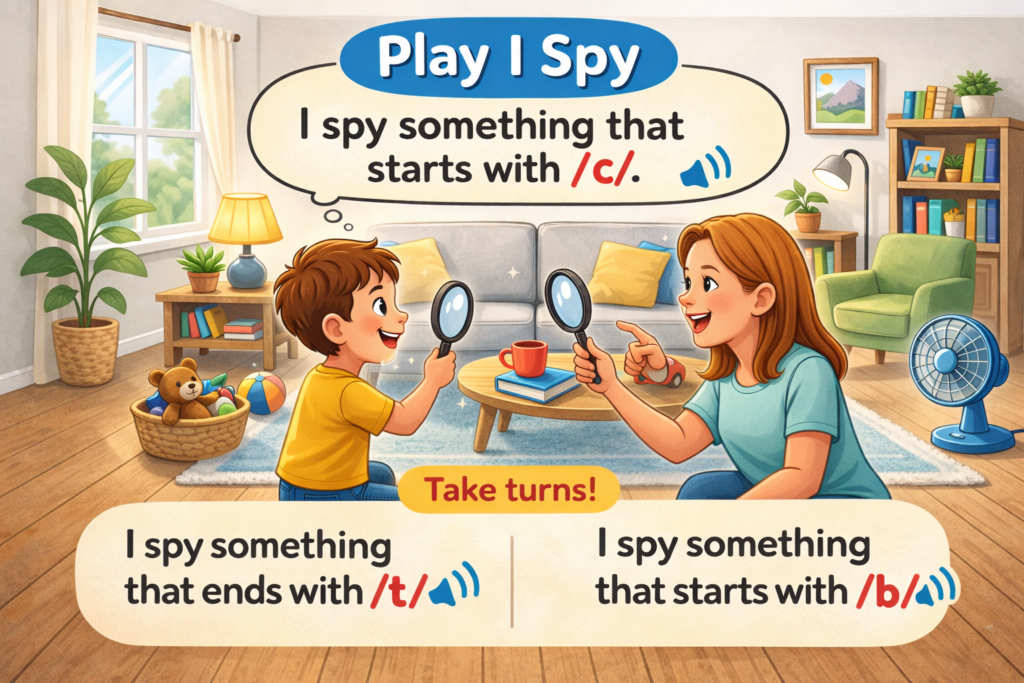
Say:
- “I spy something that starts with the sound /c/.”
- “I spy something that ends with the sound /n/.”
- “I spy something that starts with /b/.”
Your child looks around the room and identifies an object that matches the sound.
For example:
- /c/ → couch
- /n/ (ending sound) → fan
- /b/ → book
Encourage your child to say the word aloud and emphasize the target sound (for example, “C-c-couch” or “fa-nnn”).
To increase the challenge:
- Start with beginning sounds before introducing ending sounds.
- Add middle vowel sounds once your child is ready.
- Let your child be the “sound caller.”
- Play in different settings such as the kitchen, car, playground, or grocery store.
This activity helps children generalize letter–sound skills beyond worksheets while strengthening listening skills, sound isolation, and confidence.
2. Switch the Letters (Hands-On Word Building)
Choose a three- or four-letter word (for example, pig). Mix up the letters and place them on the table in front of your child (e.g., i, p, g). Position the letters about one to two feet away so your child has enough space to work.
Next, give your child a sheet of paper with three (or four) blank spaces like this:
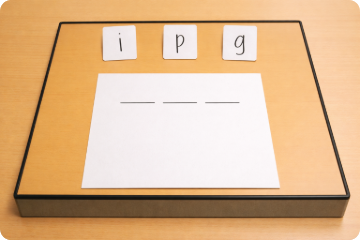
Then say the word aloud or show a picture of the word and give this instruction:
“Switch the letters around to build the word pig on the lines below.”
Encourage your child to say each letter sound as they move it, and then blend the sounds together to read the completed word.
You can increase the challenge by introducing word families (pig, big, wig, dig), asking your child to write the word after building it, or having them identify the beginning or ending sound before rearranging the letters.
3. Play “Letter Sound Go Fish”
Turn your picture–sound flashcards into a simple and engaging card game.
Create two cards for each target sound (for example, two pictures that begin with /c/, such as cat and car). Shuffle the cards and deal five to each player. Place the remaining cards in a pile in the center.
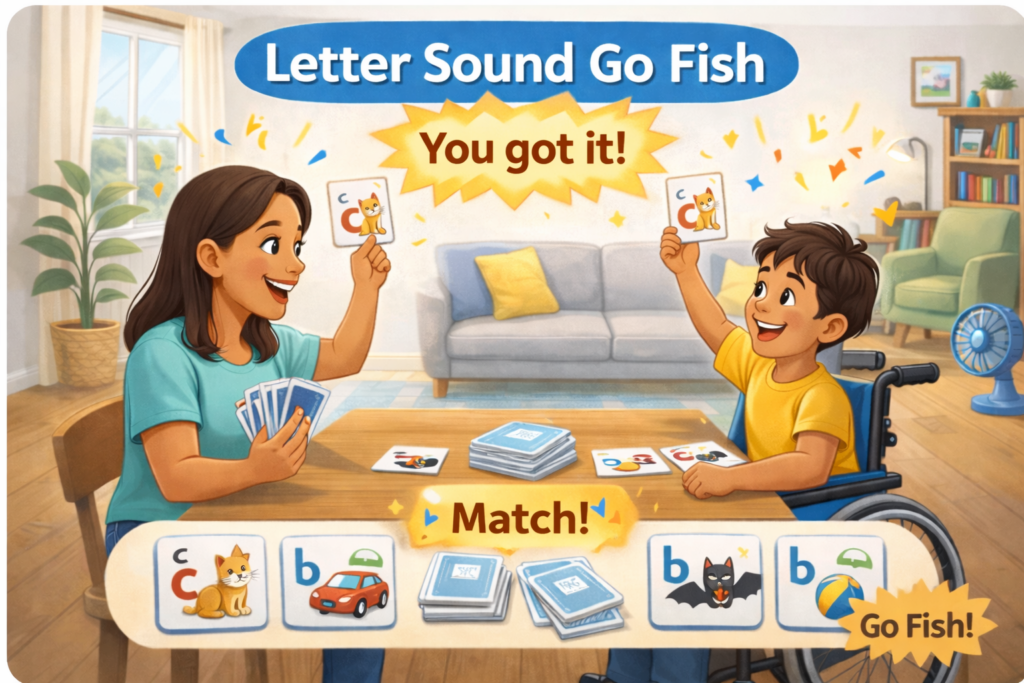
Players take turns asking:
- “Do you have a picture that starts with /b/?”
- “Do you have a picture that ends with /t/?”
If the other player has a matching sound card, they hand it over. If not, they say, “Go Fish,” and the player draws from the pile.
When a player collects a matching pair based on the same beginning or ending sound, they keep the pair. The player with the most pairs at the end wins.
To modify the game:
- Start with beginning sounds only.
- Use fewer sounds for younger learners.
- Require the child to say the word and isolate the sound before keeping the pair.
- Mix uppercase and lowercase letter cards.
This game builds sound discrimination, repetition through play, listening skills, and confidence with phonics in a social setting.
4. Jump to the Letter Sound (Movement-Based Phonics Game)
Place four letters on the floor or wall (as shown in the example below). For example: C, A, T, S.
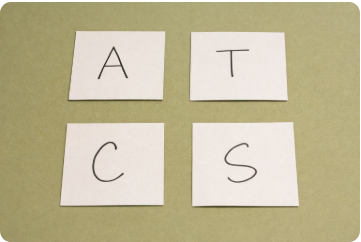
This activity can be used in two different ways to teach letter sounds and early spelling skills:
Option 1: Spell the Word in Order
Say a word such as “cats.” Have your child jump to each letter in order—C → A → T → S—while saying the sound of each letter as they land on it. After completing the word, have them blend the sounds together to read the word aloud.
Option 2: Jump to the Letter That Makes the Sound
Call out a letter sound (for example, /t/). Your child must jump to the letter that makes that sound. This version can be done in any order and works well for practicing quick sound recognition.
To increase engagement, try:
- Hopping instead of jumping
- Tip-toeing to the correct letter
- Using a timer for added motivation
- Having your child clap and blend the word after spelling it
This multi-sensory phonics activity combines movement with sound recognition, which can be especially helpful for children who benefit from active or hands-on learning.
5. Make Your Own Phonics Bingo
Create a Bingo grid by drawing one on paper or using a computer program. You can use a 5×5 grid (25 boxes) or simplify it to 3×3 (9 boxes) or 4×4 (16 boxes) for younger learners.
Place simple pictures inside each box. Choose pictures that represent clear beginning or ending sounds such as apple, banana, cat, dog, sun, hat, or bed.
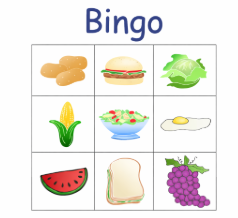
Place simple pictures inside each box. Choose pictures that clearly represent beginning or ending sounds such as apple, hat, sun, dog, bed, or cat.
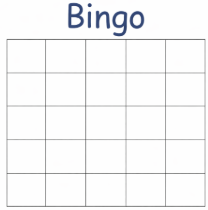
- Call out a letter sound. If your child has a picture that begins with that sound, they cover it.
- Call out a letter. If your child has a picture that begins with that letter, they cover it.
- Call out an ending sound. If your child has a picture that ends with that sound, they cover it.
- Show a picture and have your child identify the beginning or ending sound before covering it.
When your child fills a row vertically, horizontally, or diagonally, they win Bingo.
This activity strengthens letter-sound recognition, listening skills, and sound discrimination in a fun, game-based format.
6. Create Picture–Sound Flashcards
Create flashcards with a picture on one side and the corresponding beginning or ending letter sound on the other.
For example, if you are focusing on beginning sounds, show a picture of a cat on the front and write C on the back. If you are practicing ending sounds, write T on the back instead.
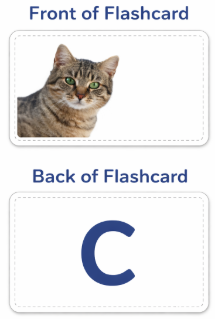
You can draw your own pictures, print simple images, or use clipart. Keep the pictures clear and easy to identify so children can focus on the letter sound.
To use the flashcards:
Show your child a picture and ask, “What sound does this word start with?” (or end with).
If they answer correctly, show them the back of the card to confirm.
If they are unsure, give them another try before modeling the correct sound and having them repeat it.
To make the activity more engaging, try:
• Tossing a soft ball between cards
• Doing a quick movement break after every five cards
• Sorting cards by beginning sounds
• Grouping rhyming words together
Flashcards help strengthen phonemic awareness, sound recognition, and early decoding skills.
7. Run to the Letter Sound (Wall Version – Quick Recognition)
Tape four letters onto the wall, spaced apart (for example: C, A, T, S).
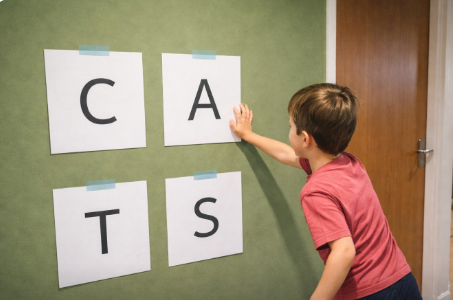
Call out a letter sound. Your child runs to the letter that makes that sound, taps it, and runs back to the starting point.
This activity focuses on quick sound identification rather than spelling in sequence.
To increase engagement:
- Hop to the correct letter
- Skip to the letter
- Tip-toe to the letter
- Count how long it takes to find the correct letter
This version works especially well for practicing listening skills and rapid letter–sound recall.
8. Fill in the Missing Letter (Phonics Worksheet Practice)
Provide your child with a worksheet that shows a picture and a partially completed word. Your child looks at the picture, says the word aloud, and fills in the missing letter based on the correct sound.
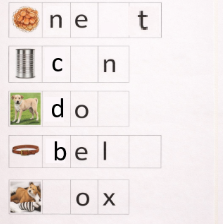
Encourage your child to:
- Say each sound slowly
- Identify whether the missing letter is at the beginning, middle, or end
- Blend the sounds together after completing the word
This activity strengthens sound segmentation, letter–sound correspondence, and early spelling skills.
Optional Support: Add a Letter Bank
For children who may need additional support, provide a letter bank at the top of the worksheet.
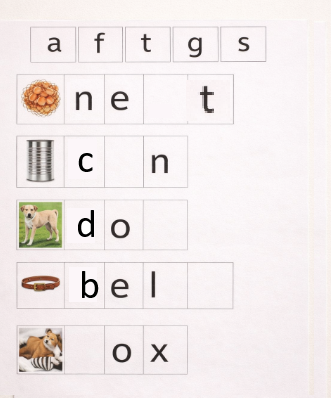
A letter bank:
- Reduces frustration
- Encourages independent problem-solving
- Builds confidence
As your child becomes more comfortable identifying sounds, gradually remove the letter bank to increase the level of challenge.
9. Spell Your Name (Personalized Letter Sound Practice)
You can use this same phonics approach to help your child learn how to spell their own name.
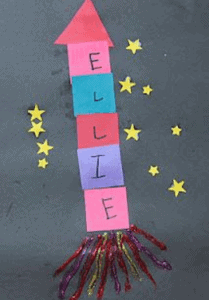
Write each letter of your child’s name on separate pieces of paper, sticky notes, or craft squares. Mix up the letters and place them in front of your child.
Begin by saying the first sound in their name and ask them to choose the letter that makes that sound. Continue identifying each sound until the full name is built in order.
For example, if the name is “Ellie,” say:
- “What sound do you hear at the beginning of your name?”
- “What letter makes the /ĕ/ sound?”
- Continue sound by sound until the name is complete.
You can repeat the activity several times to build fluency and confidence.
10. Sing the Alphabet Sound Song
Music is a powerful way to reinforce letter–sound connections.
Use the tune of the traditional alphabet song, but replace the letter names with letter sounds. For example:
“/a/ is for apple,
/b/ is for ball,
/c/ is for cat,
/d/ is for dog…”
Continue through the alphabet using simple, familiar words that clearly represent each beginning sound.
The tune is similar to the traditional alphabet song. You can find a helpful example by searching YouTube for the “alphabet sound song” by Kidstv123 (shown in the video below), or you can create your own version at home.

To make it more engaging, try:
- Clapping along as you sing
- Pointing to letters while singing
- Holding up flashcards for each sound
- Pausing to let your child fill in the sound or word
If your child is ready, try singing only the sounds without the example words. This strengthens automatic sound recall and builds confidence.
Singing letter sounds regularly helps develop phonemic awareness, memory, and early reading fluency in a fun, low-pressure way.
When to Seek Help: Addressing Learning Needs in Children
If your child continues to struggle with letter sounds despite consistent practice, consider reaching out to their teacher, reading specialist, or pediatrician for guidance. Early support can help identify underlying challenges and prevent long-term reading difficulties.
You may also find these resources helpful:
How to Use Schedules to Improve Behavior
3 Ways to Use Timers to Encourage Homework and Chore Completion
Video Presentation
You Also Might Like This Video-Storybook


Rachel Wise is the author and founder of Education and Behavior. Rachel created Education and Behavior in 2014 for adults to have an easy way to access research-based information to support children in the areas of learning, behavior, and social-emotional development. As a survivor of abuse, neglect, and bullying, Rachel slipped through the cracks of her school and community. Education and Behavior hopes to play a role in preventing that from happening to other children. Rachel is also the author of Building Confidence and Improving Behavior in Children: A Guide for Parents and Teachers.
"Children do best when there is consistency within and across settings (i.e., home, school, community). Education and Behavior allows us to maintain that consistency."
Releated Topics